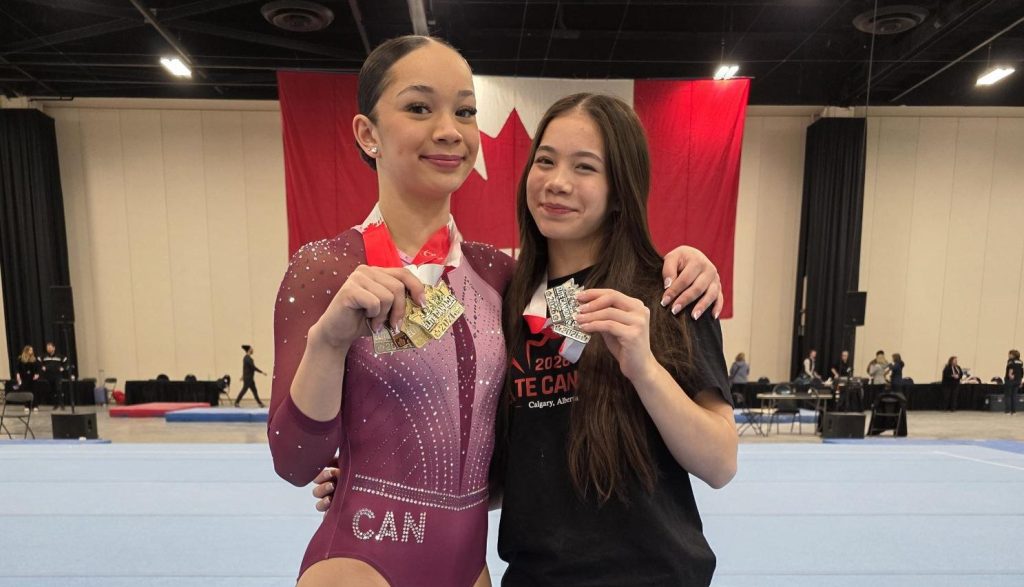
Canadian sisters Lia and Olivia Redick are quickly becoming names to watch in the gymnastics world. Sixteen‑year‑old Lia is already a standout senior elite—she’s the 2025 Pan Am beam champion, 2026 Elite Canada all-around champion and a committed LSU Tiger, marking her as one of Canada’s most exciting emerging talents. Her younger sister, Olivia, is carving out her own path as well; after returning from an injury that sidelined her for two years , she recently earned the silver all‑around finish in the novice division at Elite Canada, signaling her strong potential as she moves toward the senior ranks. I sat down with the sisters to talk about what life is really like training side by side—and how they’re growing together in a sport that never slows down.
On weekdays, Lia and Olivia Redick follow almost the same routine. They wake up early, commute together and spend a few hours in a high-performance program at school that lets them fit classes around training. After that, they head to the gym for five hours of practice. By the evening, no matter how tiring the day has been, the family sits down to dinner together.
“It’s kind of the only time we all see each other,” Lia says. “We just talk about everything — school, gym, work. It’s something we’ve always done.”
The structure might surprise an outsider. Nothing really changes from Monday to Friday; the schedule repeats itself with quiet precision. Even on weekends, when training pauses, Lia coaches recreational gymnastics, working with groups of 5 and 7-year-olds on Saturdays.
“We do everything together,” Olivia says. “Except school, and even then, it’s just for a few hours.”
Their school’s high-performance program is designed for athletes like them, serious competitors who need flexibility. Lia’s in high school; Olivia’s in eighth grade. Their classmates include a friend already committed to UConn for hockey, soccer players aiming to go pro and other gymnasts with NCAA dreams. To qualify for the program, athletes must train a certain number of hours each week. It’s not for casual participants.
But beneath that routine, they’re at very different moments in their gymnastics journeys. At 16, Lia is fresh off a breakout year: a senior international debut, a gold medal on beam at the Pan American Championships and a commitment to LSU to compete in the NCAA, her long-time dream. At 13, Olivia is emerging from nearly two years sidelined by a back injury, rediscovering competition, confidence and her place in the sport.
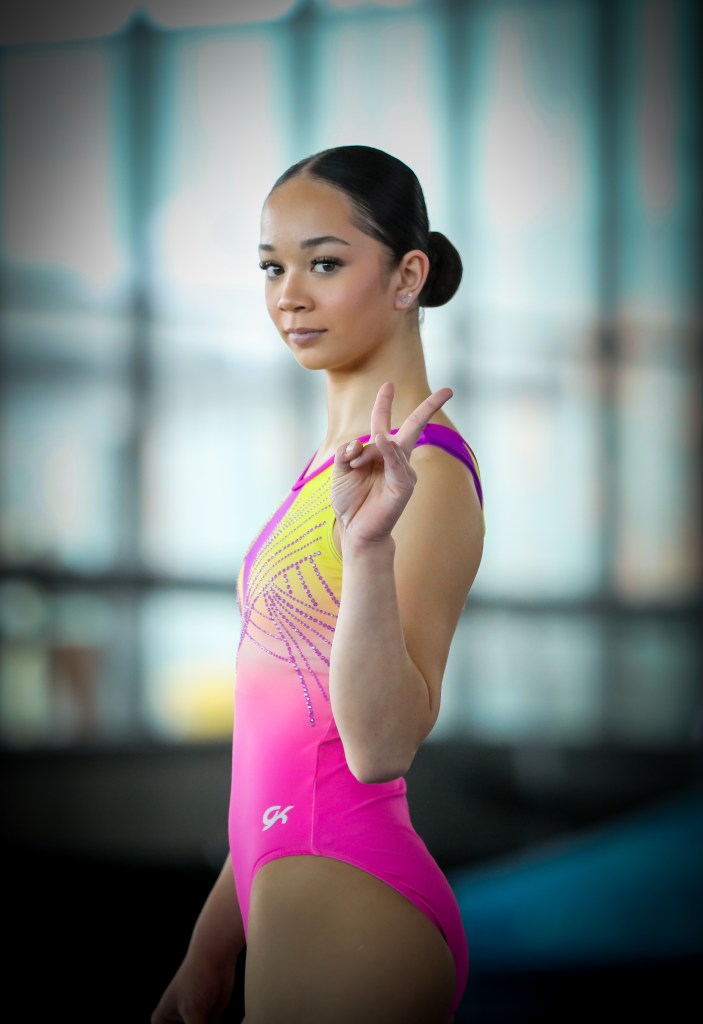
From the outside, Lia can appear intimidating— focused, composed, unshakeable under pressure. Olivia finds this perception amusing.
“I’ve seen a lot of people say that she’s intimidating,” Olivia says, laughing. “They’re like, ‘Oh my gosh, she’s really cool, but she’s really intimidating.’ And I think it’s really funny because outside of gym, she’s not at all like that. She’s the silliest person ever.”
It’s a duality Olivia has studied carefully. Watching Lia compete taught her that success isn’t about having the biggest skills in the gym. “You don’t need all these crazy skills to be at the top,” Olivia says. “It’s the way you perform and your technique that really gets you there.”
Lia, for her part, is keenly aware of being watched, not just by Olivia but by younger gymnasts who see her as an example. “I see all the kids in my group as my sisters,” she says. “All the other girls are always watching me, so I try and put on my best performance at practice and competition.”
That sense of responsibility can be heavy, especially on hard days. “Obviously sometimes if I’m not in the mood, if I’m frustrated and upset, it’s hard to still be a role model,” she admits. “But most of the time I’m just like, you know what? There’s kids watching me. There are kids who look up to me. I gotta try my best no matter what.”
That drive to show up, even when frustrated, comes directly from their coach Lena Yermolchuk— someone both girls credit as creating the foundation of everything they’ve achieved.
“She’s the reason we’re here,” they say. “She pushes us every day because she believes we can do it.”
Her philosophy is straightforward: execution before difficulty. Skills earned, not rushed. “She doesn’t want us to have crazy difficult skills,” Lia explains. “She wants us to be able to do skills that we can hit perfectly and hit consistently. Her main focus is amazing execution, and then we work on the difficulty.”
It’s an approach that has shaped both sisters, but in different ways.
For Olivia, trying her best became a daily practice when a fractured back kept her from progressing with her peers for nearly two years. She continued to train five hours a day, condition relentlessly and attend competitions to cheer from the sidelines as teammates moved ahead.
“That was the hardest part,” she admits. “Seeing all my friends and teammates move up when I couldn’t. I just had to stay there.”
But the restriction forced creativity. Unable to train normally, Olivia worked on strength and control. It was during this time that she learned the Homma flares beam mount, an unusual, eye-catching skill rarely seen in women’s gymnastics, using pommel horse work that didn’t aggravate her injury.
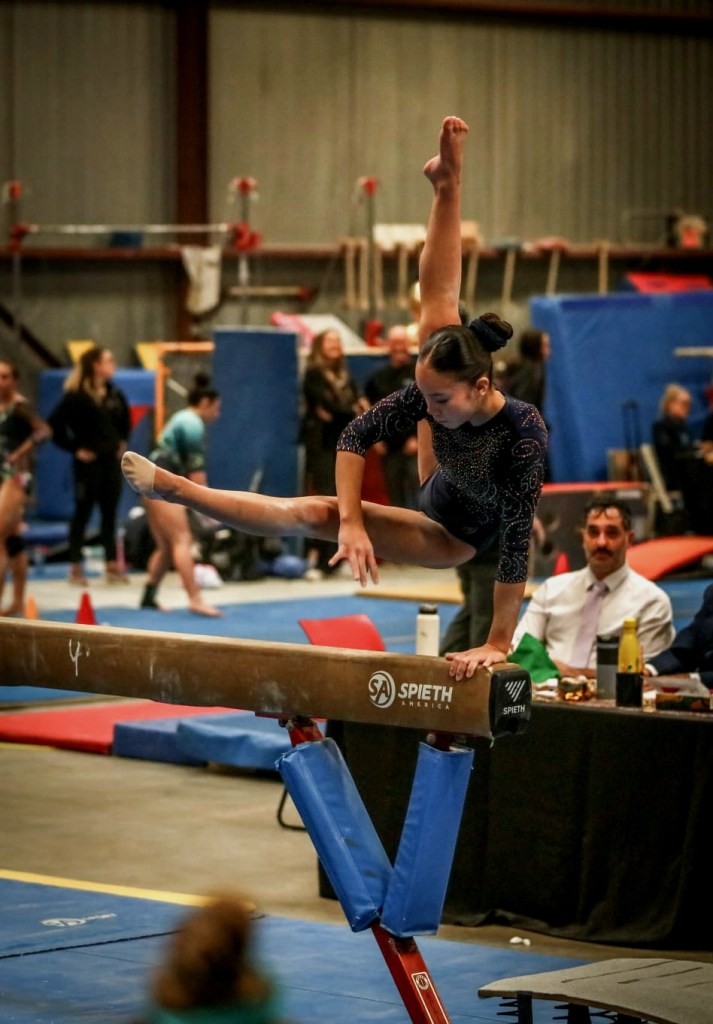
When she finally returned to competition, people noticed. “A lot of people have been coming up to me saying how much stronger I look in my gymnastics,” she says. “It makes me really happy. It’s been so much easier to do things now.”
Her comeback hasn’t been rushed. Two Level 9 meets eased her back into competition, and that patience has clearly paid off. She competed at the recent Elite Canada meet in the novice age group, where she took home silver in the all-around.
“The scariest part is just going from two years off right away to a higher level,” she says.
Still, she knows what direction she’s heading: elite competition, Team Canada and a potential run at the 2028 Olympics in Los Angeles, where she’ll be 16 — just old enough to compete.
“Ever since I was young, I’ve always wanted to go to the Olympics,” Olivia says. “It’s been my biggest dream since I started gymnastics.”
For Lia, June brought a different kind of breakthrough, one that happened on a four-inch-wide beam at the Pan American Championships.
The day of the beam final was chaos. It was June 15, the first day NCAA coaches could make contact, and messages flooded her phone that morning. She forced herself not to look. The schedule for the final changed repeatedly. She was told she had an hour to prepare, then suddenly no time at all.
“I just wanted to hit my routine,” she says. Nothing more.
Beam finals had haunted her before. She always made them and always faltered. But this time, something clicked. One skill led to another. The fear gave way to momentum.
“I did my mount and I did my acro, and I’m terrified of those two skills,” she explains. “I hit them and I’m like, okay, I got this. I just have to finish the rest and I’m done. It’s like a flow state. Once I hit the scary parts, I just knew — I had it.”
She watched the leaderboard in disbelief as scores came in. “I was like, wait, I might get a medal. And then I see that I came first and I wanted to cry. I was like, there’s no way this just happened. I must be dreaming.”
Back home, Olivia watched the livestream with her family. The feed didn’t show scores live, just Lia’s routine, then nothing.
“We were praying that she would just stay on the beam because this was a big moment for her,” Olivia says. “As soon as the score popped up, all of us started screaming. I was crying so much.”
Soon after, the family welcomed a new addition, an eight-week-old cocker spaniel named Jango, a gift to celebrate. He’s still very much in his chaotic puppy phase. “He’s so goofy and full of energy,” the girls say.
Lia’s commitment to LSU felt natural once it happened, but the decision was rooted in small, vivid moments: a campus glowing in the Louisiana heat, purple-and-gold lights flashing during a recruiting photoshoot, freshman Nina Ballou DJing while teammates danced.
“The lights are off, there’s purple and gold lights shining everywhere, and we’re putting on the leos,” Lia recalls. “It was the best time I’ve had.”
The environment mattered as much as the gymnastics. The sense of belonging. The friendships already forming with girls like Reese Esponda, Sage Bradford and her Canadian teammate Zoe Cadrin, who visited and subsequently also committed with her.
“I’m going to be on a team with those girls every day,” she says. “And I loved them.”
As for what comes next — NCAA, elite competition, LA 2028 — Lia allows herself uncertainty. “It’s all a blur,” she admits. “My dream was always to go to the NCAA. But now that I’m seeing the potential that I have, it’s making me feel more secure that I want to try for the Olympics. I feel like I have a shot.”
“We’ve kind of been opposite,” Olivia explains. “Ever since Lia was young, she’s always wanted to do NCAA. Ever since I was young, I’ve always wanted to go to the Olympics. But we both want to do both.”
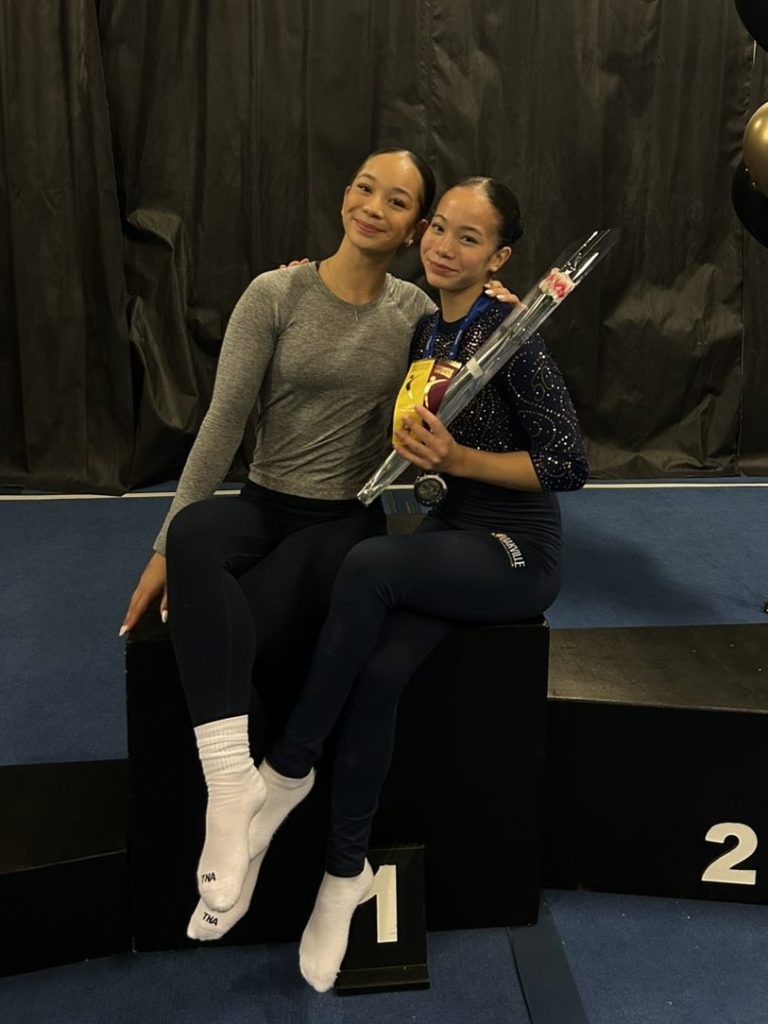
Through all of it — the daily grind, the victories, the setbacks — one thing anchors them: that nightly dinner together. It’s a ritual they’ve never had to discuss or plan. It simply is. The whole family, gathered around the table, talking about their days, the moment when gym becomes just one part of the conversation, not the whole thing.
The routine is predictable. Comforting, even. Wake up. Commute together. Train together. Come home. Sit down to dinner.
Well, almost predictable. No one’s quite sure what Jango will do next.
Article by Katie Couldrey

 Tumble Talk
Leave a comment